Welcome to my blog, a place to explore and learn about the experience of running a psychiatric practice. I post about things that I find useful to know or think about. So, enjoy, and let me know what you think.
I've posted a fair amount about Big Pharma, and how they market drugs they know to be ineffective, or even unsafe, how they buy off doctors to be Key Opinion Leaders, or just active prescribers of their drugs.
And I've been smugly patting myself on the back for not using drug pens or post-its, etc. But not quite. When I meet with a new patient, I tend to take notes. And since I don't have a chart yet for that patient, I use a clipboard with plain, looseleaf paper. I don't pay much attention to the clipboard, because I've been using it so long I don't even notice it. How long? Since residency. I know this because it's a Zyprexa clipboard, and I haven't gotten stuff from drug reps since I was a resident.
Sorry for the crappy photo, but it's some pretty glaring advertising, no? I don't understand what the little dude at the bottom is supposed to symbolize.
Is it a big deal that I use a zyprexa clipboard? I don't know. I feel like I should be more cognizant of what it might mean to patients. Does it make them think I'm going to throw an antipsychotic at them? That I get lots of stuff from drug reps?
Regardless of what it means to my patients, I think there's something to the fact that it's insinuated itself so thoroughly into my work life that I don't notice it anymore. It seems broadly emblematic of the situation with drug companies. They're part of our thinking. They're just there, no questioning required. Of course I use a Zyprexa clipboard, who doesn't use all that cool, free stuff the drug reps give away?
I decided to make my own symbolic gesture, and get rid of it. But I do need a clipboard. I can probably dig up some old thing at home, but I thought I'd get a really fun clipboard, to make up for my loss.
And this is it:
the hold-tight
Lime Green Clipboard
From Poppin. Set me back all of $5, a small price to pay for ejecting Big Pharma from my office.
While I was at it, I decided to get some fun office stuff:
the cut-above
White Scissors
This pair will beat rock and paper every time.
the most-writeous
White Letter Size Writing Pads
the write-away
Bikini Medium Spiral Notebook
the always-on-point
White Retractable Gel Luxe Pen
The clipboard is simple and perfectly functional. The scissors work well and have white blades. The paper is dense and has a nice hand. The notebook is cheerful. And the pens are cool-looking but write scratchily.
And not only is Poppin not paying me to write this, but they don't even know I exist. Which is good, because that way they can't target their marketing at me, like the Lilly rep who gave me the Zyprexa clipboard.
I've been reading Ben Goldacre'sBad Pharma. It's even more disheartening than Let Them Eat Prozac. I believe he has a newer edition out, but the one I'm reading was published in 2012, so it's still fairly recent. The problems with how drugs are regulated are mind-boggling.
As an example, the FDA requires only 2 studies for a new drug to get approval. These are drug vs. placebo studies. Basically, the drug company has to show that their new drug was better than placebo for whatever its indication is. It does not have to prove that it's any better than existing drugs with the same indication. And these studies don't have to last very long.
The time to approval has been decreasing, too. In the 80's ACT UP was instrumental in getting laws passed to push not-completely checked out drugs through the system, so that people who were dying of AIDS could have access to potentially life-saving meds. And that makes sense. If you know you're going to die without the drug, and with the drug, you might live a little longer, then it's worth the risk.
But apparently, the legislation that was created for this purpose is now being used to get other, not-as-necessary drugs approved in an expedited way. One requirement that the FDA makes is that, when safety is in question, the drug company promise to do a follow-up study to determine real world effects. This can happen when, for example, a surrogate value is used to establish the efficacy of the drug. So the drug has been shown to lower blood pressure. But it's not clear what it does in terms of improving mortality, or if it may, in fact, be harmful in longer term use than was clear from the initial study.
Well, the drug companies, promise, and largely don't follow through. And the FDA doesn't do much to follow up.
Like I said, Bad Pharma was published in 2012. So this should be old news, with perhaps some improvement since then.
But today, Reuter's published, "Study questions FDA's shorter drug approval times", referencing a study published yesterday in JAMA Internal Medicine. It found that expedited drugs underwent a median of 5.1 years of clinical testing before being approved, compared with 7.5 years for those that underwent a standard review. But in many cases safety monitoring trials that were supposed to be conducted after the products were approved were either not conducted, not completed, or not submitted to the FDA... ...Of the (20) drugs studied by Moore and Furberg in 2008, the FDA required 85 follow-up trials to monitor for safety. By 2013, only 40 percent of those studies had been completed. I'm really not sure what the FDA expects when it asks multi-billion dollar Big Pharma to promise to do follow-up studies. Goldacre cites one case in which the FDA followed up so many years later that the drug was off patent, and the pharmaceutical company didn't care if it was removed from the market. Why not have some teeth? Hey! You want your expensive drug expedited through the approval system? Okay! Chuck over a few million dollars to an independent agency, which will then offer a grant to have the follow-up study done by independent investigators. The drug will go on the market, but a couple years down the line, if that study determines that the drug is less safe than you claimed, you'll be subject to hefty fines, and possible criminal charges. I mean, seriously? "Big Pharma, pretty please will you do a follow up study?" What are they thinking?
If you read my recent post, The Vicissitudes of Kong, you'll know about AbbVie filing suit to prevent the EMA (European Medicines Agency) from gaining access to the data from their trials.
David Healy is asking people to sign his petition, which requests that AbbVie, and InterMune, another pharmaceutical company that has filed suit to prevent access to its data, drop their respective lawsuits.
Obviously, people need to make their own decisions about whether to sign, but take a look at it, and if you think it has merit, and you're so inclined, you might want to sign it.
There's a scene in Peter Jackson's version of King Kong where the girl, Ann, (Naomi Watts) has been carried off by Kong, and somehow manages to escape. She then comes face to face with a T-Rex. Kong shows up, angry that she's run off, but willing to fight to save her, and there's a split second where she has to make a choice between the two, and it's completely clear to both Ann and the audience who she's better off with. Because Kong, as big and scary and destructive as he may be, is not actually trying to hurt her. Whereas good 'ol T-Rex wants only to kill and devour her for lunch.
This is kind of how I feel about insurance companies vs. Big Pharma. Insurance companies can only survive by charging outrageous premiums and then denying coverage. The harm is innate. But I truly believe that if pharmaceutical companies could produce drugs that were always helpful and never harmful, they would flourish and be pleased as punch.
Here is where my analogy falls apart, because Kong is in love with the girl, and I attribute no such caring and altruism to Big Pharma. And while some drugs are unquestionably helpful, and others are questionably helpful, none are free of adverse effects.
In that vein, there's been a lot of online chatter about a recent panel discussion that took place in Brussels, about the potential for conflict between public health and commercial confidentiality in clinical trials run by pharmaceutical companies. See, for example, this post on 1 Boring Old Man, or this one on DavidHealy.org. The ongoing issue is, of course, data transparency.
For some reason, I'm having trouble embedding the video, but here's a link:
The video is almost an hour long, and since time is a limited commodity, and Breaking Bad and Dexter have only a couple more episodes, each, priorities need to be established.
But I'll give you the gist of it, as well as a transcript of a brief section.
The panel members, from various agencies, I believe, including the European Federation of Pharmaceutical Industries and Associations (EFPIA) and the Pharmaceutical Research and Manufacturers of America (PhRMA), speak about how important it is for companies to maintain confidentiality in their clinical data, so they can't be scooped by competitors. The claim is that this benefits the public, and public health, because it allows the companies to continue to pursue the noble goal of discovering, producing, and selling new drugs.
One of the panel members is Neal Parker, a US lawyer and representative of AbbVie, a spinoff of Abbott Pharmaceuticals, and makers of Humira. AbbVie has already taken action in the courts to prevent the European Medicines Agency from releasing data on Humira to a rival company. It won an interim judgment preventing release of this data on April 30th of this year.
Parker emphasized the importance of confidentiality, and included adverse events as potential data to be kept from the public. There were several responses to this from the audience.
Hans Georg Eichler, the EMA’s senior medical officer, said, “I have been a regulator for many years and I am totally flabbergasted.”
And Aginus Kalis, head of the Dutch Medicines Evaluation Board, asked, “Are you aware you are working in the healthcare industry, with patients and human beings?”
While I agree with these sentiments, I think the outrage is counterproductive in this setting. It makes Eichler and Kalis look like histrionic foils to Parker's man of reason. And the last thing I want is for people to buy into Parker's rhetoric.
Because, overall, he is reasonable. He says that AbbVie will consider revealing data on a drug by drug basis, and that as long as the purpose of the revelation is for the scientific community to learn from it, and as long as appropriate safeguards are put in place so the lucky scientists don't go running to AbbVie's competitors in Bangladesh, there's no reason they won't share their information.
One audience member asked if these scientists would be free to share the data with clinicians. I don't quite recall what the response was, and this may be an indication that some double-speak was going on.
Later in the session, a woman in the audience asked Parker to give an example of an adverse event that AbbVie would not release to the public. He told her he couldn't think of a case where AbbVie wouldn't be willing to share this information. She said, "But it's happened before." And he responded with something like, "I can only speak for AbbVie." The subtext: I can't talk about SSRIs and suicidality.
Since most people reading this are not going to watch the whole megillah, I want to point you in the direction of what I thought was the most telling of Neal Parker's comments. Parker is responding to a question from an audience member, asking about why it's so important to maintain this confidential data, when presumably, the interprative analysis gleaned from the data is already available to the public in the discussion and conclusion sections of the product label information.
It runs from minutes 19:41 to 20:47, and this is my transcript:
The detail of the give and take of the problem solving which is reflected in the narratives of some of these clinical study reports is internal sensitive information which is nowhere reflected in the label.
A company’s,...the process of getting these products approved with the regulatory agencies is a give and take of issues, challenges, um, reworking of data in response to regulators’ concerns or concerns that we have identified and raised ourselves, which needs to be explained and articulated in documents that we submit to regulators to get products approved. And if I’m a competitor to Abbvie, and I’m in a competitive landscape, where there are a lot of products on the market, and I want to enter that market, the first thing I want is Abbvie’s clinical study report, ‘cause I want to know what problems I am gonna have to confront when I try to get a product approved, and that is a competitive advantage, and that’s why we consider this information, depending on the circumstances, CCI (confidential clinical information).
(Boldface mine)
It’s the “reworking of data” that no one outside the company has access to that really worries me.
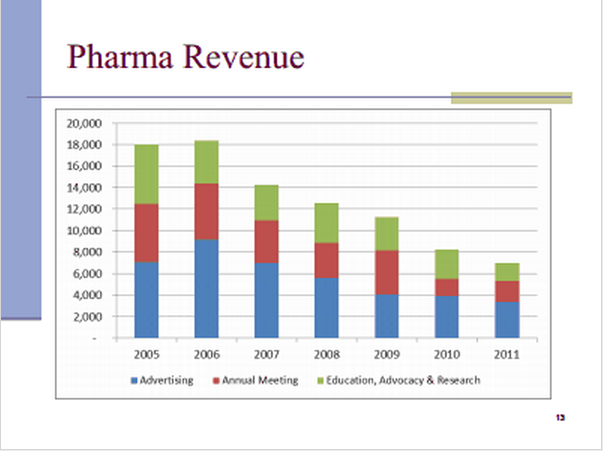
Check out this article in Psychiatric News, if you haven't already. Jeffrey Lieberman, president of the APA, asks us to be nice to poor, little Big Pharma. He notes past problems, "including high drug prices, aggressive marketing practices and direct-to-consumer advertising, efforts to buy influence with physicians, and, perhaps most egregiously, the suppression of data on drugs’ dangerous side effects." He goes on to say: But let’s face it, they need us and we need them. We must recognize the important, beneficial role that drug companies have long played in all areas of medicine. While not minimizing problems, we simultaneously must remember how products have improved the quality of health care and quality of life in our society, and their funding has helped to advance research, public outreach, and training. He finishes up with: We now are moving forward with careful vigilance in ways that recognize the value of industry relationships. Under the auspices of the American Psychiatric Foundation (APF), interactions with industry are helping to restore important relationships. ...I believe that the rules and models for informational, educational, and research engagement can and should be developed and applied in ways that allow for our optimal engagement with companies. Doing so would not only help us learn from the mistakes of the past; it would help us improve the future for our profession and our patients. I agree with the fact that we need them. Unless we want to put all our patients on Lithium and St. John's Wart, the meds have to come from someplace. And I don't fault Big Pharma for trying to make a buck or two billion. But I also agree with the fact that they need us. No prescribers, no sales. So why do we have to be nice to them? And why does the president of the APA have to ask us to do so? Sorry if I'm skeptical, but: GlaxoSmithKline has admitted that some of its senior Chinese executives broke the law in a £320m cash and sexual favours bribery scandal. And: Big pharma mobilising patients in battle over drugs trials data. The veracity of this last one is a little controversial, I suspect because Big Pharma intervened (See Eye For Pharma). The idea is that if pharmaceutical companies make their data transparent for review and interpretation by the world at large, like in RIAT, science may be compromised, and private patient information may be revealed. I guess the world at large doesn't understand science as well as pharmaceutical companies do. And oh yeah, data for subjects in drug trials are anonymous. (Please check out 1boringoldman.com for a more extensive discussion of this controversy) So, again, why is the APA on a kick to endorse Big Pharma? To quote Danaerys Targaryen, "I am only a young girl, and know little of such matters." But I wonder what the APA gets out of the endorsement. According to Gary Greenberg, regarding the APA's financial picture: Income from the drug industry, which amounted to more than $19 million in 2006, had shrunk to $11 million by 2009, and was projected to fall even more. Membership was dropping, off by nearly 15% from its highs, and with it income from dues and attendance fees. Journal advertising was off by 50% from its 2006 high of $10 million. I looked up the APA's 2012 Treasurer's Report, and found the following charts: